

It’s no secret that the ErgoMulti table is designed because we wanted to create the optimum training table. We believe we have succeeded. Fortunately, we are not the only ones who share that opinion.
Annette Kjærsgaard is an occupational therapy specialist with a PhD in dysphagia. Dysphagia is a swallowing disorder and a symptom that may occur in connection with neurological diseases like Parkinson’s disease, sclerosis and brain injuries. In her latest book about dysphagia, Anette has made a series of professional descriptions, where she uses the ErgoMulti table for the rehabilitation of people with dysphagia.
By Annette Kjærsgaard, occupational therapyspecialist with a PhD in dysphagia, owner of Dysfagiklinikken (Dysphagia Clinic)
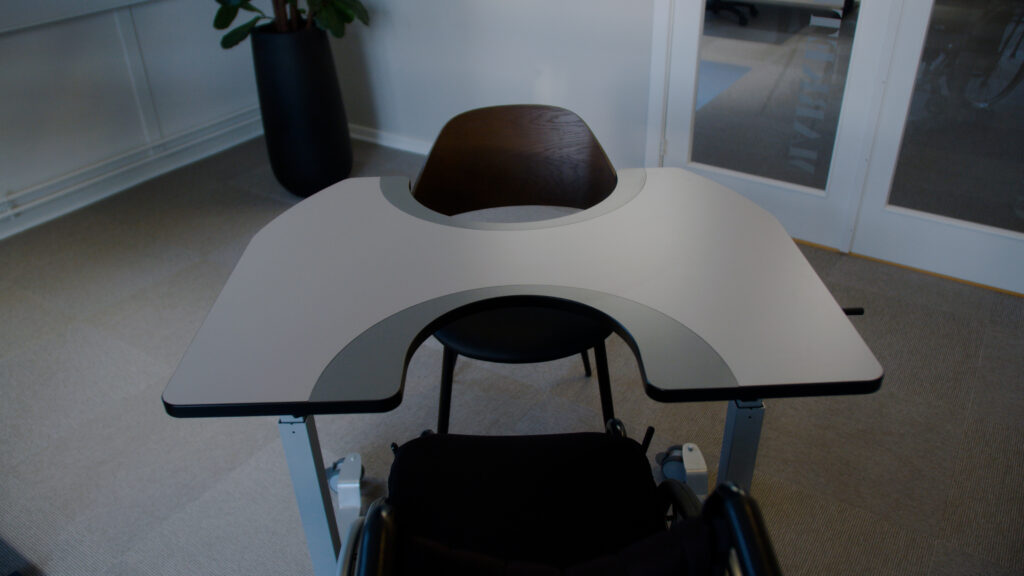
The ErgoMulti table can support a stable exit position for the user and at the same time support a suitable working position for the occupational therapist when conducting face, mouth and throat therapy. The table design with two carvings and rounded edges makes it possible for the occupational therapist to get close to the user without having to sit or stand in inappropriate working postures.
The design of the ErgoMulti table with carvings, brake wheels and the possibility for manual height adjustment makes it possible for the user to sit well supported with the feet on the floor, the stomach towards the table edge and the forearms/elbows on the table regardless of whether the user sits on an ordinary chair, an active or comfort wheelchair or a treatment bench.
The boomerang system with two different sizes of carvings on the user’s side of the table,
gives the user suitable support of the forearms/elbows no matter if the person is a child/adult or if the person has a slight/sturdy build. The crescent-shaped leaf which can be mounted on the therapist’s side of the table makes the table useful for training of several activities, e.g. a meal where there has to be room for a glass, a plate and cutlery, or for the examination of the mouth where there has to be room for a glass with water, napkin, examination light, etc.
The ErgoMulti table can be adjusted individually for children and adults and can be used for several persons and activities. Such a table is ideal for hospitals and institutions where examination and treatment of people with functional impairments of the face, mouth and throat are conducted as it supports an optimum sitting and head position for the patient/user and makes it possible for the occupational therapist to obtain a good working position. Furthermore, the table is easy to clean, user-friendly and of a quality that makes it an investment that lasts for years.
In the below, four professional scenarios are described where the ErgoMulti table is used in clinical practice when examining the face, mouth and throat.
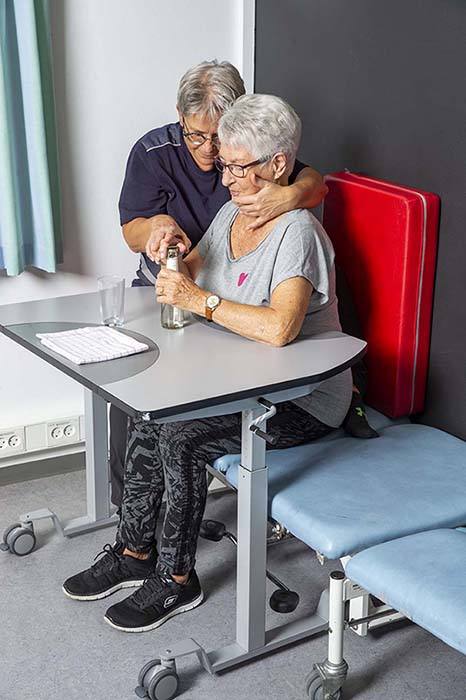
The patient is examined with therapeutic eating focusing on the pre-oral phase, where she is guided to open a bottle. In this situation, the ErgoMulti Table functions as an Accessible table that supports both the patient’s posture and the therapist’s working position. The patient sits on a bench with the feet on the ground, the stomach towards the table edge and both forearms/elbows supported on the ErgoMulti Table. This positioning creates stability through weight-bearing on the arms and helps establish the correct sitting alignment. As the patient cannot hold her head independently, there is a need for the occupational therapist to assist her with a jaw hold from the side.
This setup at the ErgoMulti Table ensures an ideal starting point for drinking, which is the aim of this exercise.
The occupational therapist sits on a pack next to the patient on the bench. By becoming slightly elevated, she can hold the jaw from the side without straining her shoulders unnecessarily.
To support stability and posture, the therapist:
This positioning makes it possible for the occupational therapist to feel and adjust the patient’s sitting position if the pelvis slides forwards during the examination. The close positioning supported by the Accessible table setup ensures that both posture and head alignment can be corrected continuously.
The rounded edges of the ErgoMulti Table make it possible for the occupational therapist to get close to the patient. This proximity allows better support of a stable and symmetrical sitting and head posture while maintaining an appropriate working posture for the therapist. To ensure maximum safety and stability during therapeutic eating:
Engaging the brakes is a prerequisite not only in this situation, but also in the following professional scenarios where the ErgoMulti Table is used as an Accessible table in dysphagia rehabilitation.
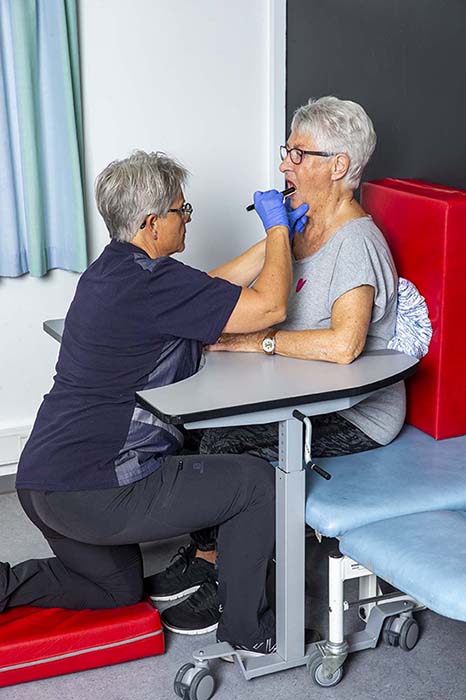
The occupational therapist conducts a visual examination of the mouth, focusing on inspection of the lips, teeth, gums, tongue, cheeks and soft palate during rest. In this situation, the patient can hold her head independently.
Therefore, an exit position is chosen where the occupational therapist sits in front of the patient to obtain a clear and unobstructed view of the mouth during the examination. The ErgoMulti Table functions here as an Accessible table, allowing optimal positioning for both patient and therapist.
The patient sits on a treatment bench and is positioned carefully to ensure stability and proper swallowing mechanics.
This setup at the Accessible table supports a stable and aligned sitting position during the visual examination.
When the ErgoMulti Table is used with two carvings, the occupational therapist can sit closely in front of the patient and slightly below eyesight. This positioning is important to create a good starting point for swallowing.
If the patient looks up at the occupational therapist, it will shorten the neck and make swallowing more difficult. By sitting below eye level, the therapist supports a more natural head and neck alignment.
During the examination, the occupational therapist:
The ability to get close to the patient and obtain elbow support from the ErgoMulti Table reduces static strain. This is particularly important during longer examinations, as a jaw hold from the front may otherwise entail sustained static work for the hand, arm and shoulder.
In this way, the ErgoMulti Table not only functions as an Accessible table for the patient, but also provides essential ergonomic support for the occupational therapist.
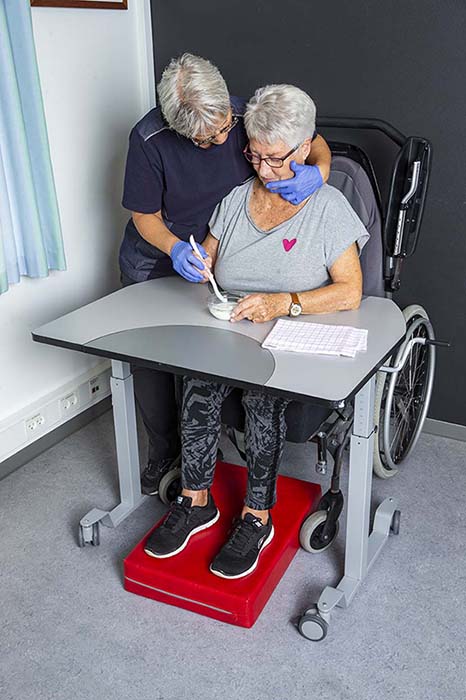
Therapeutic eating is conducted here as an examination where the patient is guided in the pre-oral phase to move the spoon to the mouth. The focus is on eye-hand and hand-mouth coordination.
In this setup, the ErgoMulti Table functions as an Accessible table, providing the necessary forearm and elbow support during the eating activity.
The carving of the ErgoMulti Table makes it possible to support the patient’s forearms and elbows while seated. This ensures stability and controlled movement throughout the task.
This Accessible table setup makes the movement more precise and supports coordination training during therapeutic eating.
The patient sits in a comfort wheelchair because she has limited body stability and cannot sit without support. To optimise positioning at the ErgoMulti Table, adjustments are made to the wheelchair:
This positioning ensures weight-bearing through both the arms and the feet, creating a more stable and functional sitting posture at the Accessible table.
As the patient cannot hold her head independently, the occupational therapist uses a jaw hold. She stands on the right side of the patient to support the body, head and jaw position during the examination.
The rounded edges of the ErgoMulti Table make it possible for the occupational therapist to get close to the patient. This proximity allows better support of the patient’s exit position while simultaneously ensuring an appropriate and ergonomic working posture for the therapist.
In this way, the ErgoMulti Table serves both as an Accessible table for the patient and as a tool that supports safe and effective working conditions for the professional.
The patient is examined with a tactile examination of the mouth, where sense of feeling, mouth movement and saliva swallowing are assessed. In this situation, the ErgoMulti Table functions as an Accessible table, supporting both correct posture and precise clinical assessment.
The patient sits in an active wheelchair because controlled support is required during the examination. To achieve an optimal position at the ErgoMulti Table, several adjustments are made:
This Accessible table setup ensures stable weight-bearing through the arms and promotes proper head and upper body alignment during the tactile assessment.
In this example, the patient could also sit on an ordinary dining chair without arm supports, with a pillow or wedge in the back and the feet placed on the floor, while still benefiting from the support provided by the ErgoMulti Table.
The ErgoMulti Table’s two carvings make it possible for the occupational therapist to sit below eyesight, close to the patient and maintain good eye contact from the front. This positioning is important for achieving both clinical precision and effective communication.
At the same time, the Accessible table design allows the therapist to maintain a stable working position while supporting the patient with a jaw hold from the front.
By enabling close proximity and elbow support, the ErgoMulti Table supports both patient safety and ergonomic working conditions during tactile oral examinations.
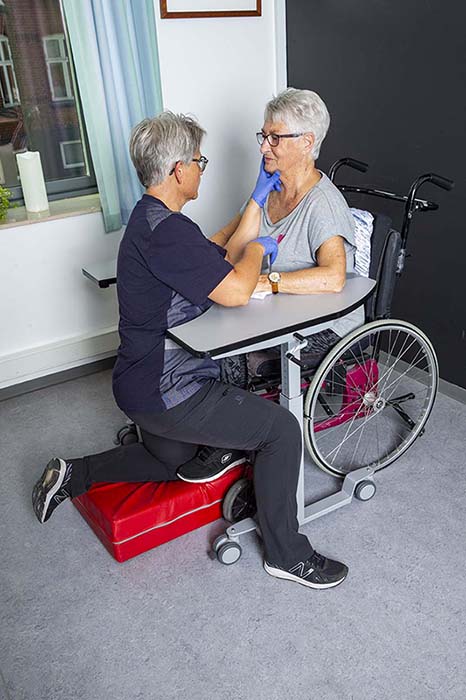
In the descriptions, Anette uses the ErgoMulti table in specific rehabilitation situations with a patient. It is a professional evaluation of how the table works using occupational therapeutic methods. Anette’s professional assessment confirms that the ErgoMulti table is ideal for rehabilitation, and it demonstrates how the tables well thought out design makes it possible to help and support the patient in the best possible way.
With the right aids in training, therapy and rehabilitation, the patients will experience faster progress in the rehabilitation, and the occupational therapist gets the optimum working positions. In consequence, the table helps both patients and professionals to get a better everyday life.
Annette Kjærsgaard, occupational therapist with a PhD in dysphagia, owner of Dysfagiklinikken (Dysphagia Clinic).
Annette Kjærsgaard was trained as an occupational therapist in 1989, and in the mid-1990s she participated in designing the ErgoMulti table. Since then, Anette has taken a Ph.D. in dysphagia and has more than 30 years of experience in examination and treatment of face, mouth and throat. Also, Anette holds a master’s degree in occupational therapy (MScOT), is Facial-Oral Tract Therapy (F.O.T.T.) instructor and an occupational therapy specialist in neurorehabilitation. Read more about the Dysphagic Clinic here.


