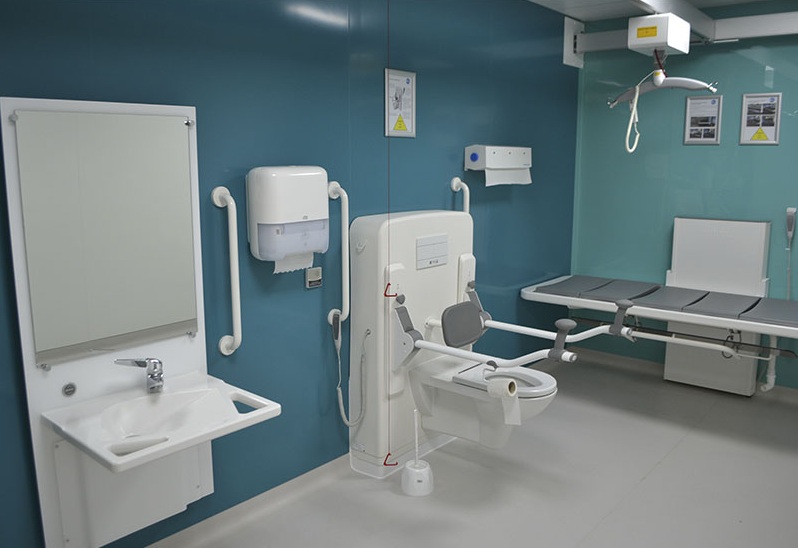

A Changing Place toilet is a large accessible toilet designed in accordance with The British Standard BS 8300-2:2018.
It provides sanitary accommodation for people with multiple and complex disabilities who has one or two assistants with them. They are facilities designed for people who cannot use standard accessible toilets, as a standard distabled toilet is typically designed for individual use and does not offer sufficient room for one or more carers to assist the user. A Changing Place toilet provides more space than a standard accessible toilet, and they also provide specialist equipment to assist the user and carer. When you have a Changing Place in your building, you provide people with severe and complex disabilities with the ability to go out and enjoy public spaces in a dignified manner.
This guide provides you with answers on what a Changing Place is, how to install it and comply with the BS 8300-2:2018 regulations, what the recommended equipment is as well as examples of room layouts. If you need anything further, please do not hesitate to get in touch.
Today, 250,000 people with profound and multiple disabilities in the UK require access to a Changing Place because they are unable to use standard toilets or regular accessible toilets. Many toilets are too small to fit a user and a carer, and, often, they do not have the right facilities.
This leaves people with disabilities with one of two choices: to stay at home or go out knowing that they might have to be changed on the toilet floor.
Not only is this dangerous and unhygienic, it’s most of all undignified.
Now, Changing Places Toilets are compulsory in new buildings, and they are being installed across England – and many more are in the pipeline. This means that children and adults with disabilities can get the needed support, equipment and space when visiting public spaces.
A quarter of a million people in the UK need a Changing Place. These are people with profound and multiple learning disabilities and people with other physical disabilities who need extra equipment and space to use toilets safely and comfortably. Those in need of a Changing Place toilet include:

Approved Document M (Doc M) of the Building Regulations provides guidance on the access to and use of buildings, including the requirements for Changing Places toilets. As of 1 January 2021, the amendments to Approved Document M require certain types and sizes of new or refurbished public buildings in England to include at least one Changing Places toilet.
You can access Part M of the Building Regulations, which includes the requirements for Changing Places toilets, through the following links:
Approved Document M: Access to and use of buildings – Part M on LABC
Part M – Access to and use of buildings on Planning Portal
Changing Places toilets must be provided in new or significantly refurbished buildings that are publicly accessible and meet certain criteria, such as large public venues, shopping centers, and transport hubs.
Shopping centres, airports, railway and bus stations, town halls, educational establishments, hospitals, supermarkets, cinemas, sports stadiums and arts venues are just some of the buildings that are required to include at least one Changing Places toilet in any new builds or major refurbishments.
The Equality Act 2010 states that service providers have a duty to make reasonable adjustments where a disabled person would otherwise be at a substantial disadvantage. It also requires service providers to try and remove barriers that impede access by disabled people.
As per the Building Regulations Part M, toilet accommodation within a building must be suitable for all who use the building. The location of a toilet should also be considered, and the time taken to reach a wheelchair accessible toilet should be kept to a minimum. Here is a list of buildings that need a Changing Place:
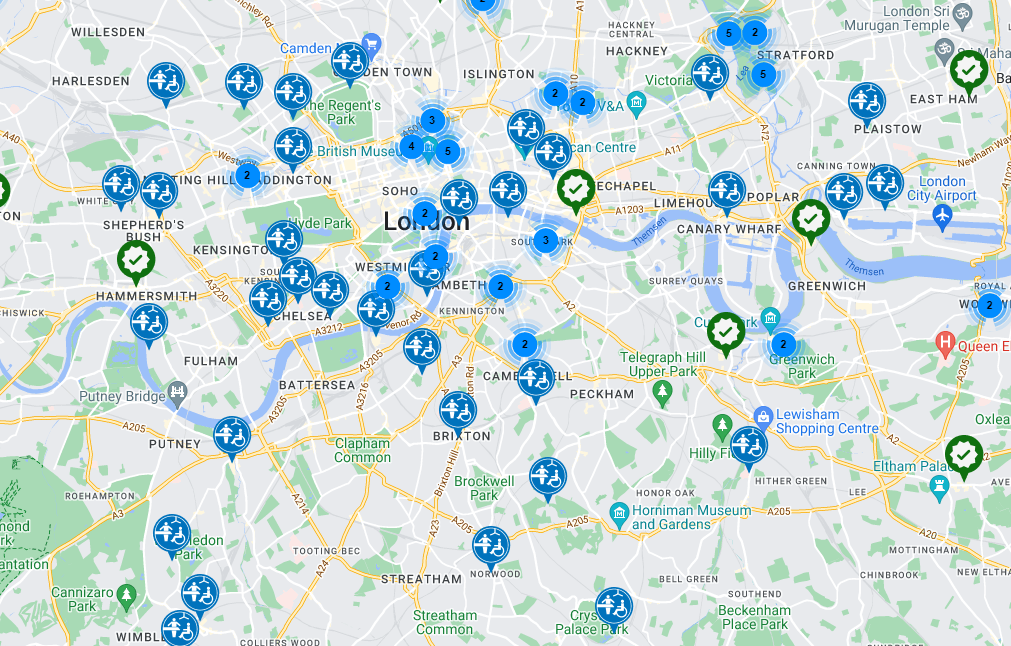
All approved Changing Places are featured on the Changing Places Map. This helps families with disabled family members plan their days out.
To register your facility as an approved Changing Place, you need to document that it meets the standards set out by the Changing Places Consortium.
When your Changing Place is registered, it will be promoted as an official Changing Place and provide the disabled community with the ability to visit your site.
To get on the Changing Places map, the facility should meet the following requirements:
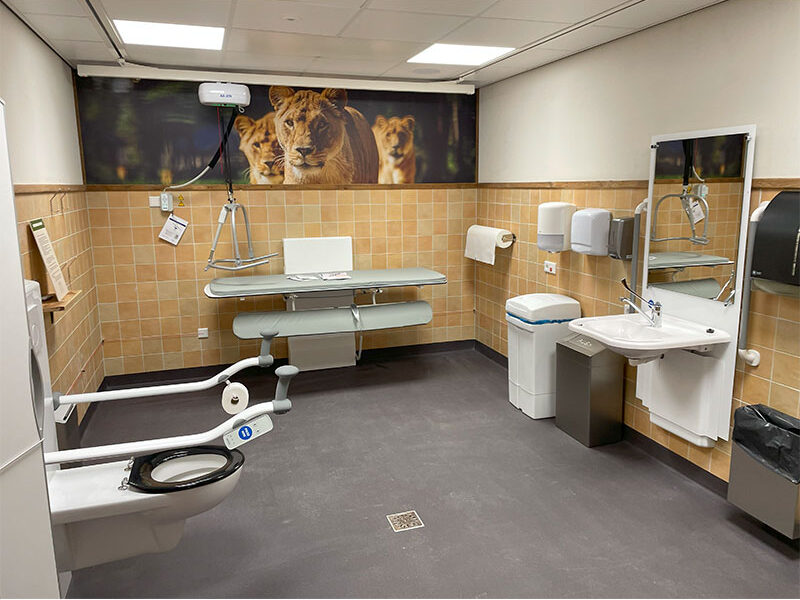
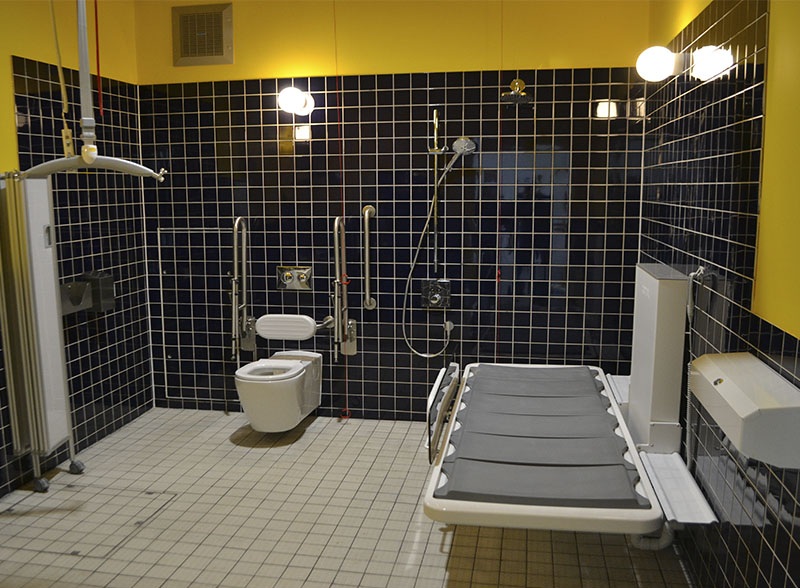
Arranging the equipment correctly ensure that people with disabilities and their carers can access and use the facility with ease. There are a couple of key considerations you should bear in mind when planning your Changing Place.
Additional equipment to be considered:
“The feedback we received was fantastic with many people commenting on how easy all the equipment is to use and how much room there was for wheelchair users and their carer or family member who may be assisting them”. Read case study about Chris MaddoxChanging Place in Burton University Hospital
We are delighted with the equipment which has been installed and I know it is going to help our many visitors with a disability. When we received the on-site training, we were all surprised by how user friendly all the equipment is and I have no doubt visitors will be able to use it with confidence”. Go to the case story here and read more
“As we normally attract visitors from all over the UK and overseas, it is imperative that we can cater for people with all levels of mobility and independence and tapping into the knowledge and experience of companies such as Ropox certainly helps us achieve this”.Go to the case story here and read more
“When we heard about the Changing Places Toilet, we immediately went for it”. Go to the case story here and read more
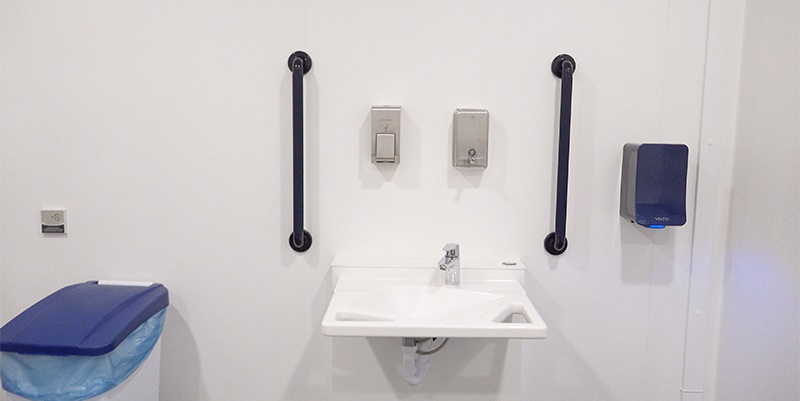
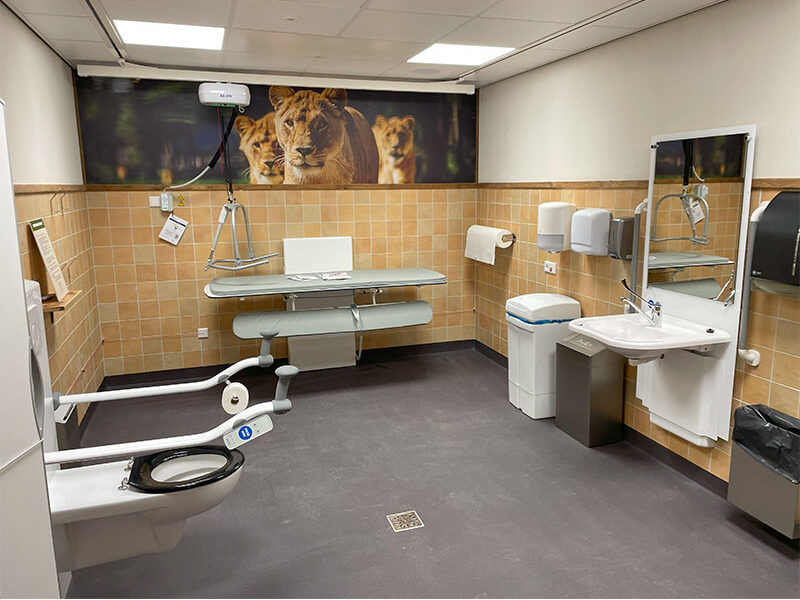
The equipment in a Changing Places toilet should be designed and planned in accordance with the British Standard BS 8300-2:2018 and the guidelines set forth by the Changing Places Consortium. These standards ensure that the facilities are accessible, safe, and comfortable for individuals with severe disabilities. Key features include a centrally placed toilet with adequate space for carers, a height-adjustable changing bench, a ceiling-mounted hoist system, height-adjustable washbasin, grab rails and toilet support arms. Adhering to these guidelines guarantees that the facilities meet the highest standards of accessibility and usability.
ROPOX offers all the necessary equipment for creating a Changing Places Toilet for disabled. Read more about Accessible Bathroom solutions here.
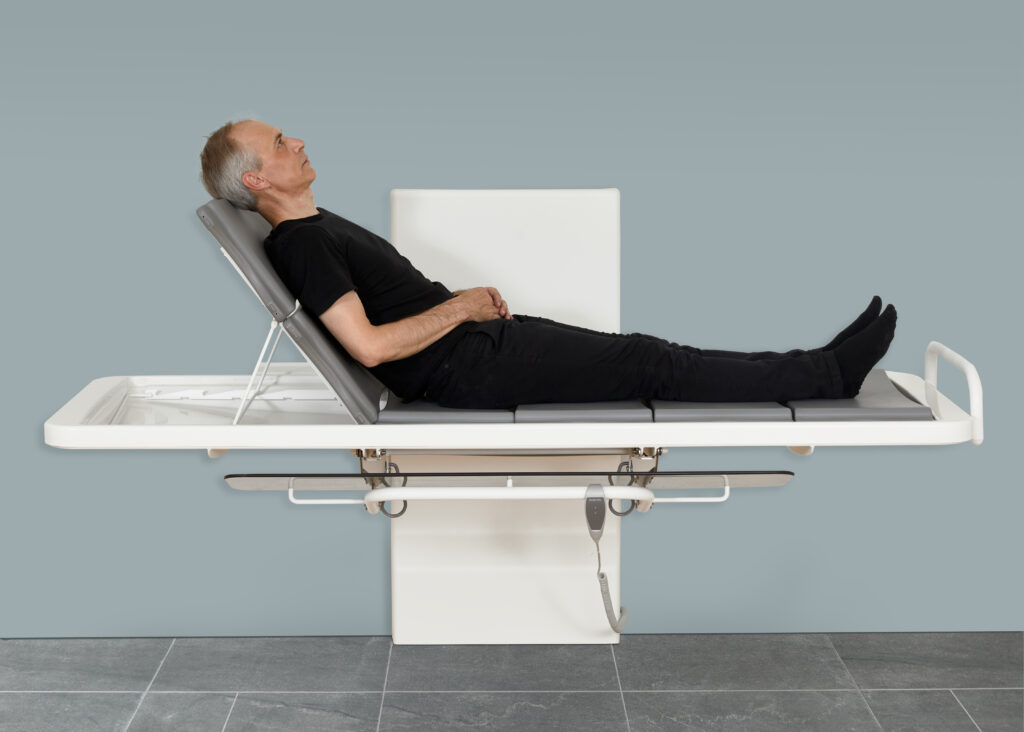
• Adult-Sized: The bench must be adult-sized with around 1800mm in length and 800mm in width.
• Height Adjustable: The bench should be height adjustable to facilitate easy transfer from wheelchairs and to allow carers to assist users comfortably.
• Wall-Mounted: The bench should be wall-mounted to provide stability and to maximize the available floor space for maneuvering
• Safety Rails: The bench should have safety rails that can be folded up or down to provide additional security for the user during transfers and changing
Explore our height-adjustable adult changing and shower beds
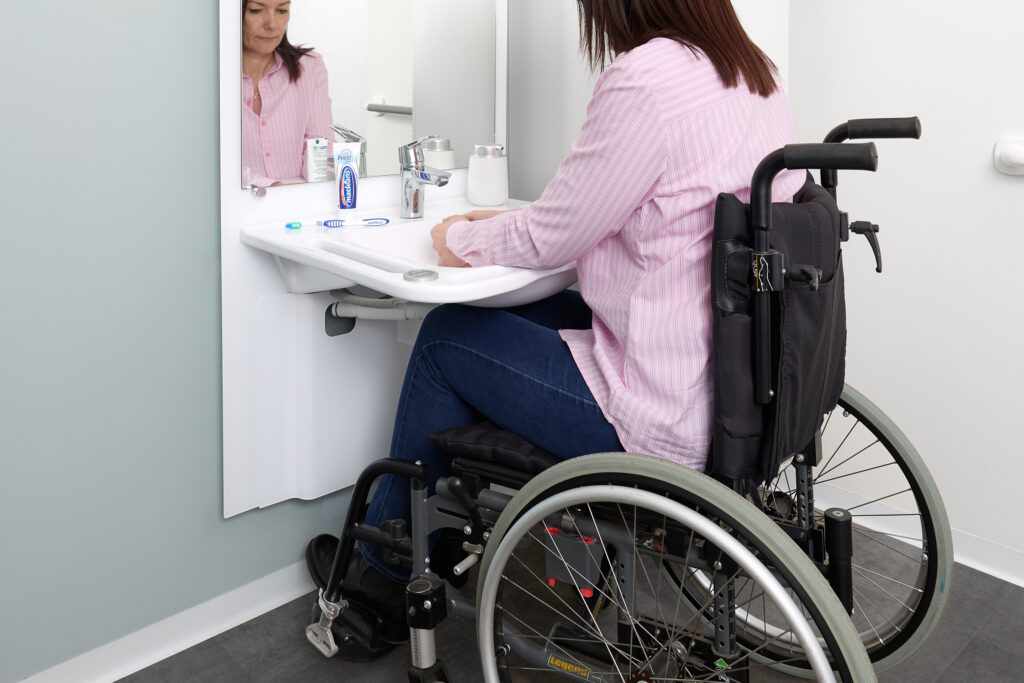
• Height Adjustable: Ideally, the washbasin should be height adjustable to accommodate users of different heights and those in wheelchairs.
• Clear Knee Space: There should be clear space below the bowl of the washbasin to allow wheelchair users to access it comfortably.
• Height from Floor: If a height-adjustable basin is not available, a standard basin can be installed at height: 720-740mm from the floor.
• Accessibility Features: The washbasin should have lever-operated or sensor-operated taps to make it easier for users to operate.

• Height: The support arms should be mounted at a height of 680-700mm from the floor to the top of the arm when in the horizontal position.
• Length: The support arms should extend at least 750mm from the wall to provide adequate support for users when transferring to and from the toilet.
• Positioning: The support arms should be positioned on both sides of the toilet to provide support from either side.
• Grip Surface: The support arms should have a non-slip surface to provide a secure grip for users.

• Horizontal Grab Rails: on the wall adjacent to the toilet, at a height of 680-700 mm from the floor. Another one should be placed on the opposite wall.
• Vertical Grab Rails: on the wall adjacent to the toilet, starting at a height of 700 mm from the floor and extending to at least 1400 mm. Another one should be placed on the opposite wall.
• Drop-down Rails: On both sides of the toilet positioned at a height of 680-700 mm from the floor when in the down position.
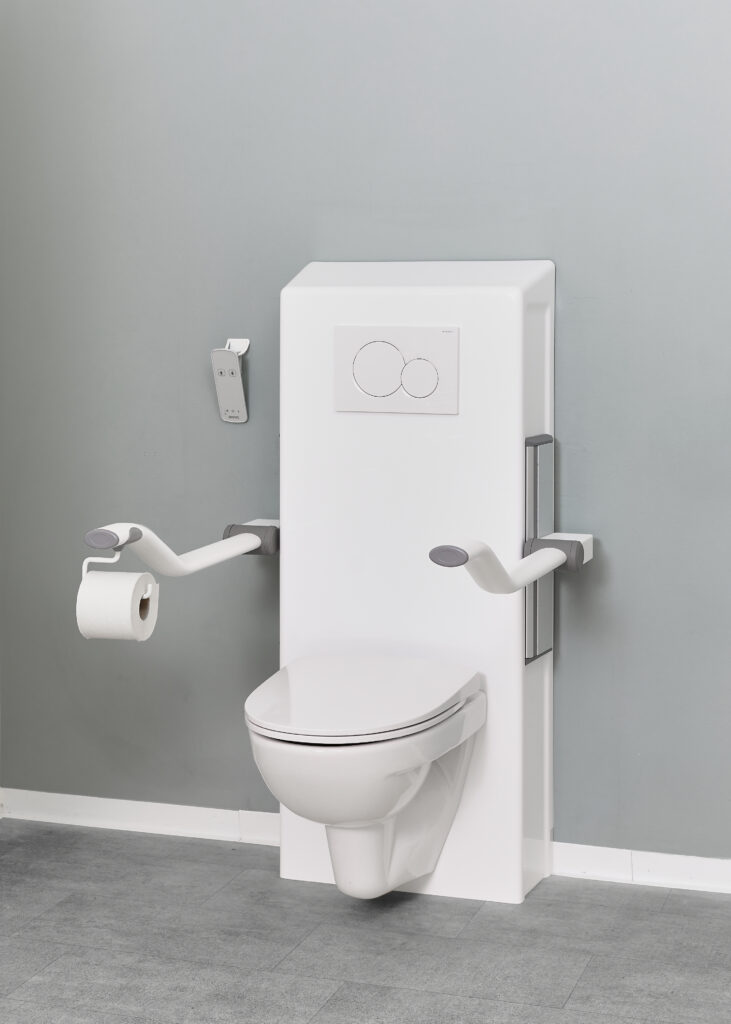
• Height Adjustability: The toilet lifter should be height adjustable with a range that spans from 400mm to 600mm above the floor.
• Weight Capacity: The toilet lifter should be robust and capable of supporting a significant weight, typically up to 200kg.
• Control Mechanism: The toilet lifter should have an easy-to-use control mechanism, such as a handheld remote or wall-mounted control panel, to allow users or carers to adjust the height as needed.
• Safety Features: The toilet lifter should include non-slip surfaces and locking mechanisms to prevent accidental movement during use.

Suki RamArea Sales Manager, sra@ropox.com
“Changing Placs is something i’m passionate about because having a Changing Place enhances and benefits the users and carers. If you need support to design the ideal bathroom layout that comply with the building regulations, I’d be happy to assist. I can also advice and support you in engaging with architects, contractors and occupational therapists to ensure the best solution and high standards in your specific project.”

Recently, there have been changes to the legislation which covers building regulations with regards to accessibility, which will see a huge increase in the number of Changing Places in the UK. Mark Sadler, UK sales manager at Ropox, explained some of the changes, and his views on them.
People need to be as aware of them as they are of baby changing facilities
While they could result in an increase in enquiries to companies such as Ropox, to be honest, these latest changes will have little effect for anything up to three or four years, especially for service users. But five years from now, I believe people will look back at the current situation with regards to changing facilities and realise how inadequate they were. The reason for such a delay in seeing the benefits is that the new rules will only apply to new build planning applications which are submitted after 1 January 2021, and we all know how long an initial submission can take in coming to fruition, especially for something as substantial as a shopping or leisure centre, motorway services, or theatres.
The big difference is that, at the moment, incorporating a Changing Places facility is optional and seen as best practice, but from 1 January next year it will be compulsory in all new building applications of certain types which are submitted after that date.
I think they could be better signposted, both within buildings and also to the wider public. This could include venues highlighting them on their website, promoting them through social media, and clear signposting from the building’s entrance. Staff awareness could also be improved. It would make such a difference if all staff at least knew what the Changing Places facility is, where it is situated, and how visitors access it.
Training is also vital. While many visitors will be familiar with the equipment found in a Changing Places facility, this will not always be the case. Therefore, I would advise that several members of staff at the venue receive training once the installation is complete to ensure there is someone either available or contactable to advise should a user require assistance.
People need to be as aware of them as they are of baby changing facilities. The last thing we want is organisations investing the money to include them in their buildings, only for it to sit there unused.
One of the biggest challenges is when the venue is a listed building, as you cannot just start knocking down walls. Sometimes, it is necessary to place the facility in an adjoining building or a portable unit. Unfortunately, on some occasions, it is just not possible to carry out an installation. Space is often an issue with existing buildings, along with finding a suitable location that is accessible for all potential users.
Over 250,000 people in the UK require Changing Places toilets to enable them to get out and about. The Changing Places Consortium is a group of organisations working to support the rights of people living with disabilities: established in 2006, they campaign for Changing Places to be installed in all large public spaces so people can access their community.
One such family is the Baker family from Oxfordshire, who have been using Changing Places for the last 13 years as their son Elliott has kernicterus, a condition which has symptoms similar to athetoid cerebral palsy. Elliott’s mother Caroline explains how they have helped the family:
“From a parent’s perspective this new legislation is fantastic news, and I wish it had been put in place years ago. Changing Places facilities have certainly changed since Elliott was born, but only really over the last few years and during this time, we have spent many hours changing Elliott in the boot of our car as there either wasn’t space or the disabled toilet was just too dirty.“
Changing Places facilities make a huge difference and definitely influence our choice of location when we are planning a holiday or family days out.
“Shopping centres are generally not great as you often have to share with the baby changing areas, which is not ideal and tend to be busy and dirty, so when you do find a Changing Places facility, it makes such a huge difference. Awareness has increased to a degree but more needs to be done so children, teenagers and adults are no longer having to get changed on toilet floors, which is unacceptable in 2020.”
Ropox is one of the UK’s leading manufacturers and suppliers of accessible bathrooms and kitchens in both domestic and care environments. They can arrange the design and full installation of Changing Places units across the UK and Ireland.
For more information on the full range of products available from Ropox, or to book an assessment,contact Mark on ms@ropox.com or 07444 577609.
Article from the OT Magazine, November 2020