

Each person is unique and has individual goals, aspirations and needs. An occupational therapy assessment should provide the clinician with an understanding on the person’s limitations on occupational performance. This section may help with documentation and clinical reasoning when recommending the Vision Table, a highly adaptable height adjustable desk designed to support independence, posture and daily activities.
Please read more about Clinical reasoning and evidence based practice document.
The information in this document can be used to assist with justification for the recommendation of the Vision Table. When working in statutory services, funding for equipment not kept in a local store or available on an agreed catalogue is usually requested via a clinical reasoning document. This is then sometimes reviewed by a manager or a panel of senior staff responsible for budgets.
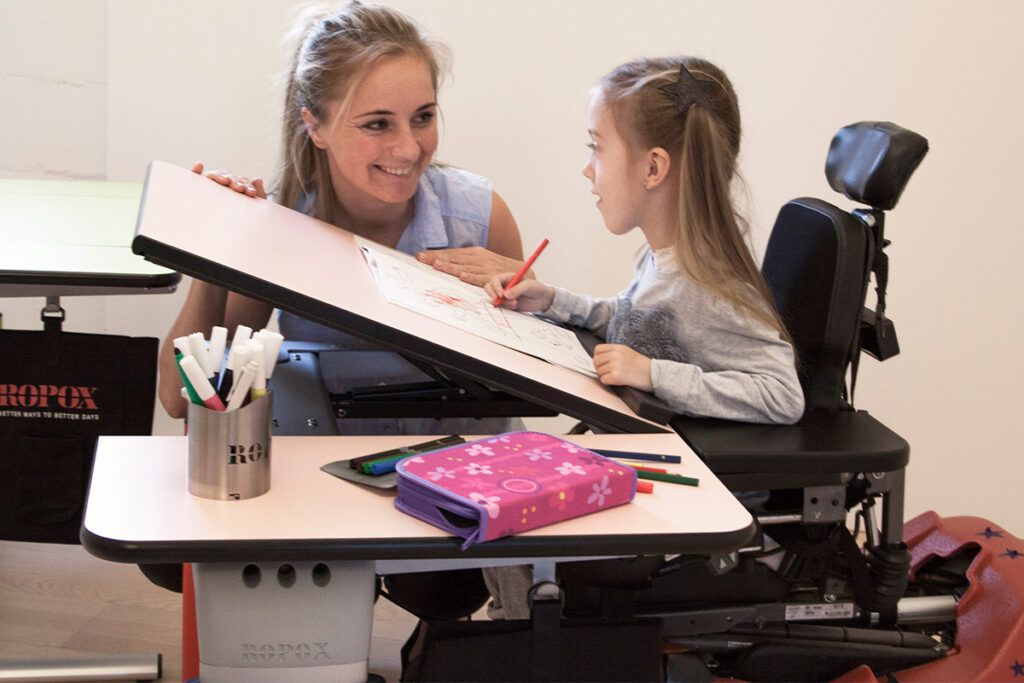
It is the reliance on this document to be a robust, clinically reasoned and risk assessed explanation of why the equipment is required, which ultimately leads to funding being agreed.
It is important to remember that RCOT (2019) states that:
“The ultimate professional rationale for your intervention or activity… is the enhancement of health and wellbeing through the promotion of occupational performance, engagement and participation in life roles”.
Furthermore, the Professional Standards for Occupational Therapy Practice, Conducts and Ethics (RCOT, 2021) stipulates occupational therapists “develop…. personalised recommendations based on the occupational performance needs, choices and aspirations of those who access the service” (section 4.5.2.).
Therefore, regardless of any criteria that may or may not be written, it is part of an occupational therapist’s code of conduct to support intervention that enhances occupational performance and supports a person’s aspirations. Any clinical reasoning should cover this, as well as risk assessments and an objective view of how a person’s wellbeing will be enhanced by the provision of equipment.
When recommending assistive equipment such as the Vision Table, a height adjustable desk designed for rehabilitation and daily use, clinical reasoning documentation typically considers:
Find more information about the Vision Table here.
A well-designed height adjustable desk such as the Vision Table can make a significant difference to everyday activities such as reading, writing, working, learning or rehabilitation training. Adjustable furniture allows users to create a comfortable and supportive working environment tailored to their body, posture and reach.
Ropox tables are developed in collaboration with users, caregivers and therapists. This ensures the design follows ergonomic principles and supports people with different mobility levels and physical abilities.
By allowing users to adjust the working height, positioning and tabletop angle, height adjustable desks help maintain an optimal working posture and reduce unnecessary strain on the body.
These benefits are particularly important in rehabilitation settings, educational environments and home care situations where furniture must support long periods of activity.
The wheelchair accessible tables from Ropox are developed in collaboration with users, caregivers, and therapists to meet ergonomic principles. This is your guarantee that they will enhance your daily life, whether you need a worktable for reading, playing, working, or training.
Our extensive range of disability-friendly tables can be adjusted in multiple ways and adapted for different purposes to meet your requirements.
Read more about our wheelchair accessible tables here.
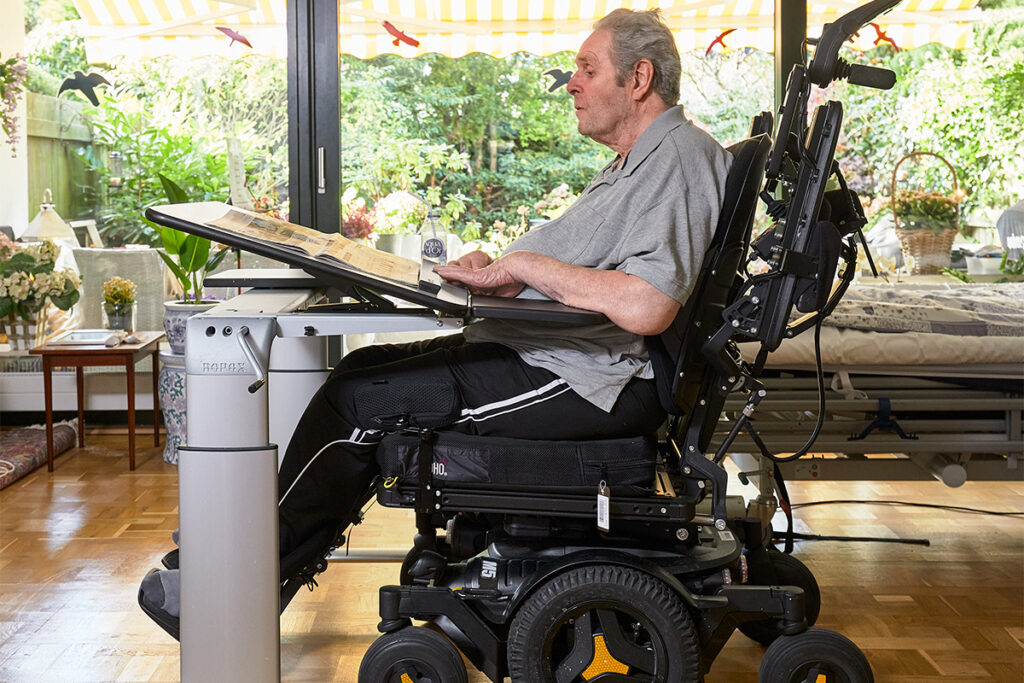
Accessible height adjustable desks include several design features that support users with different physical abilities:
These features make the tables suitable for use in private homes, schools, care environments, rehabilitation centres and healthcare facilities.
The Vision Table is a series of height adjustable desks with tiltable tabletop designed to support ergonomic working positions and everyday independence. The flexible design makes it suitable for a wide range of users including wheelchair users, individuals with limited mobility, and people who require adaptable working environments.
These tables offer an array of tabletop sizes, models, adjustment options, and a range of features that will make your life easier.
A good sitting position is essential for comfort and long-term health. Sitting for extended periods can place strain on the back, shoulders and neck. Adjustable furniture allows users to vary their position and maintain a healthier posture throughout the day.
The Vision Table supports this by allowing users to:
With the right desk, users can stay active and engaged in everyday tasks such as studying, working, reading or rehabilitation training.
Find out more about the Vision Table height adjustable desk and how this highly adaptable solution can support posture, independence and daily activities in a wide range of environments. Explore product features, clinical benefits and application guidance.
Recently, there have been changes to the legislation which covers building regulations with regards to accessibility, which will see a huge increase in the number of Changing Places in the UK. Mark Sadler, UK sales manager at Ropox, explained some of the changes, and his views on them.
People need to be as aware of them as they are of baby changing facilities
While they could result in an increase in enquiries to companies such as Ropox, to be honest, these latest changes will have little effect for anything up to three or four years, especially for service users. But five years from now, I believe people will look back at the current situation with regards to changing facilities and realise how inadequate they were. The reason for such a delay in seeing the benefits is that the new rules will only apply to new build planning applications which are submitted after 1 January 2021, and we all know how long an initial submission can take in coming to fruition, especially for something as substantial as a shopping or leisure centre, motorway services, or theatres.
The big difference is that, at the moment, incorporating a Changing Places facility is optional and seen as best practice, but from 1 January next year it will be compulsory in all new building applications of certain types which are submitted after that date.
I think they could be better signposted, both within buildings and also to the wider public. This could include venues highlighting them on their website, promoting them through social media, and clear signposting from the building’s entrance. Staff awareness could also be improved. It would make such a difference if all staff at least knew what the Changing Places facility is, where it is situated, and how visitors access it.
Training is also vital. While many visitors will be familiar with the equipment found in a Changing Places facility, this will not always be the case. Therefore, I would advise that several members of staff at the venue receive training once the installation is complete to ensure there is someone either available or contactable to advise should a user require assistance.
People need to be as aware of them as they are of baby changing facilities. The last thing we want is organisations investing the money to include them in their buildings, only for it to sit there unused.
One of the biggest challenges is when the venue is a listed building, as you cannot just start knocking down walls. Sometimes, it is necessary to place the facility in an adjoining building or a portable unit. Unfortunately, on some occasions, it is just not possible to carry out an installation. Space is often an issue with existing buildings, along with finding a suitable location that is accessible for all potential users.
Over 250,000 people in the UK require Changing Places toilets to enable them to get out and about. The Changing Places Consortium is a group of organisations working to support the rights of people living with disabilities: established in 2006, they campaign for Changing Places to be installed in all large public spaces so people can access their community.
One such family is the Baker family from Oxfordshire, who have been using Changing Places for the last 13 years as their son Elliott has kernicterus, a condition which has symptoms similar to athetoid cerebral palsy. Elliott’s mother Caroline explains how they have helped the family:
“From a parent’s perspective this new legislation is fantastic news, and I wish it had been put in place years ago. Changing Places facilities have certainly changed since Elliott was born, but only really over the last few years and during this time, we have spent many hours changing Elliott in the boot of our car as there either wasn’t space or the disabled toilet was just too dirty.“
Changing Places facilities make a huge difference and definitely influence our choice of location when we are planning a holiday or family days out.
“Shopping centres are generally not great as you often have to share with the baby changing areas, which is not ideal and tend to be busy and dirty, so when you do find a Changing Places facility, it makes such a huge difference. Awareness has increased to a degree but more needs to be done so children, teenagers and adults are no longer having to get changed on toilet floors, which is unacceptable in 2020.”
Ropox is one of the UK’s leading manufacturers and suppliers of accessible bathrooms and kitchens in both domestic and care environments. They can arrange the design and full installation of Changing Places units across the UK and Ireland.
For more information on the full range of products available from Ropox, or to book an assessment,contact Mark on ms@ropox.com or 07444 577609.
Article from the OT Magazine, November 2020
It’s no secret that the ErgoMulti table is designed because we wanted to create the optimum training table. We believe we have succeeded. Fortunately, we are not the only ones who share that opinion.
Annette Kjærsgaard is an occupational therapy specialist with a PhD in dysphagia. Dysphagia is a swallowing disorder and a symptom that may occur in connection with neurological diseases like Parkinson’s disease, sclerosis and brain injuries. In her latest book about dysphagia, Anette has made a series of professional descriptions, where she uses the ErgoMulti table for the rehabilitation of people with dysphagia.
By Annette Kjærsgaard, occupational therapyspecialist with a PhD in dysphagia, owner of Dysfagiklinikken (Dysphagia Clinic)
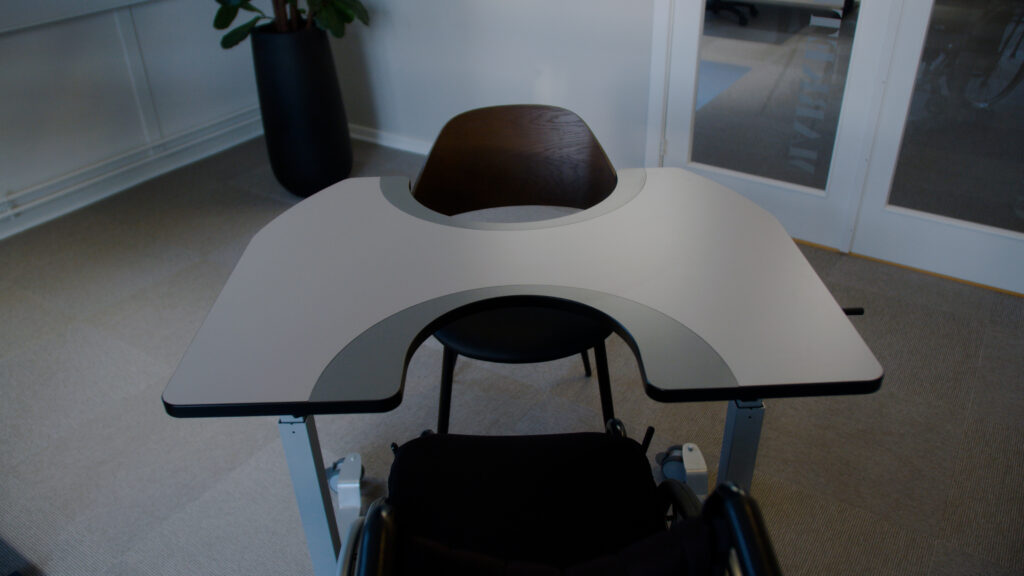
The ErgoMulti table can support a stable exit position for the user and at the same time support a suitable working position for the occupational therapist when conducting face, mouth and throat therapy. The table design with two carvings and rounded edges makes it possible for the occupational therapist to get close to the user without having to sit or stand in inappropriate working postures.
The design of the ErgoMulti table with carvings, brake wheels and the possibility for manual height adjustment makes it possible for the user to sit well supported with the feet on the floor, the stomach towards the table edge and the forearms/elbows on the table regardless of whether the user sits on an ordinary chair, an active or comfort wheelchair or a treatment bench.
The boomerang system with two different sizes of carvings on the user’s side of the table,
gives the user suitable support of the forearms/elbows no matter if the person is a child/adult or if the person has a slight/sturdy build. The crescent-shaped leaf which can be mounted on the therapist’s side of the table makes the table useful for training of several activities, e.g. a meal where there has to be room for a glass, a plate and cutlery, or for the examination of the mouth where there has to be room for a glass with water, napkin, examination light, etc.
The ErgoMulti table can be adjusted individually for children and adults and can be used for several persons and activities. Such a table is ideal for hospitals and institutions where examination and treatment of people with functional impairments of the face, mouth and throat are conducted as it supports an optimum sitting and head position for the patient/user and makes it possible for the occupational therapist to obtain a good working position. Furthermore, the table is easy to clean, user-friendly and of a quality that makes it an investment that lasts for years.
In the below, four professional scenarios are described where the ErgoMulti table is used in clinical practice when examining the face, mouth and throat.
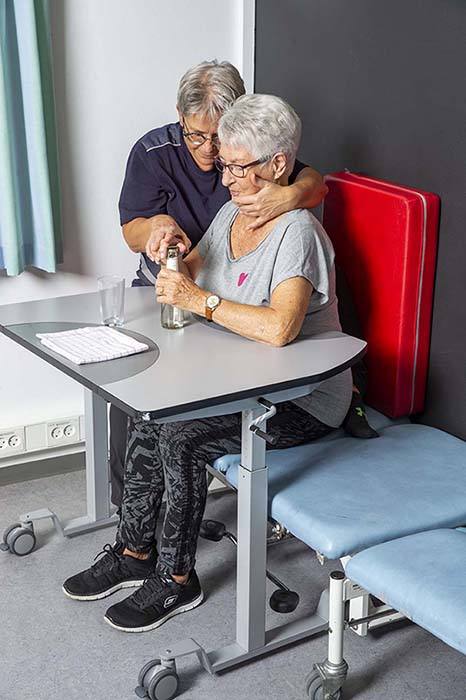
The patient is examined with therapeutic eating focusing on the pre-oral phase, where she is guided to open a bottle. In this situation, the ErgoMulti Table functions as an Accessible table that supports both the patient’s posture and the therapist’s working position. The patient sits on a bench with the feet on the ground, the stomach towards the table edge and both forearms/elbows supported on the ErgoMulti Table. This positioning creates stability through weight-bearing on the arms and helps establish the correct sitting alignment. As the patient cannot hold her head independently, there is a need for the occupational therapist to assist her with a jaw hold from the side.
This setup at the ErgoMulti Table ensures an ideal starting point for drinking, which is the aim of this exercise.
The occupational therapist sits on a pack next to the patient on the bench. By becoming slightly elevated, she can hold the jaw from the side without straining her shoulders unnecessarily.
To support stability and posture, the therapist:
This positioning makes it possible for the occupational therapist to feel and adjust the patient’s sitting position if the pelvis slides forwards during the examination. The close positioning supported by the Accessible table setup ensures that both posture and head alignment can be corrected continuously.
The rounded edges of the ErgoMulti Table make it possible for the occupational therapist to get close to the patient. This proximity allows better support of a stable and symmetrical sitting and head posture while maintaining an appropriate working posture for the therapist. To ensure maximum safety and stability during therapeutic eating:
Engaging the brakes is a prerequisite not only in this situation, but also in the following professional scenarios where the ErgoMulti Table is used as an Accessible table in dysphagia rehabilitation.
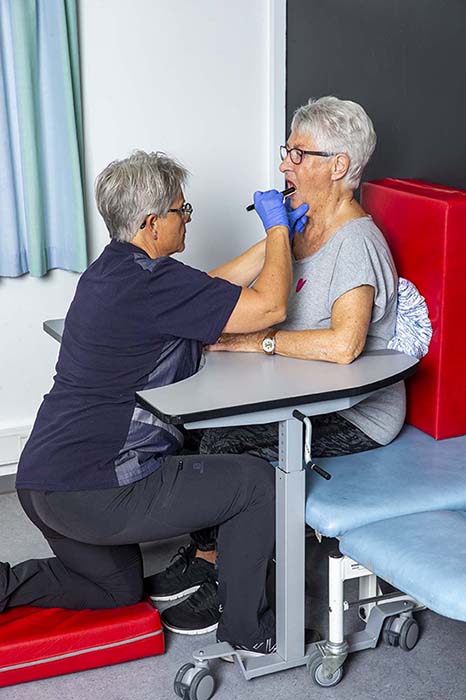
The occupational therapist conducts a visual examination of the mouth, focusing on inspection of the lips, teeth, gums, tongue, cheeks and soft palate during rest. In this situation, the patient can hold her head independently.
Therefore, an exit position is chosen where the occupational therapist sits in front of the patient to obtain a clear and unobstructed view of the mouth during the examination. The ErgoMulti Table functions here as an Accessible table, allowing optimal positioning for both patient and therapist.
The patient sits on a treatment bench and is positioned carefully to ensure stability and proper swallowing mechanics.
This setup at the Accessible table supports a stable and aligned sitting position during the visual examination.
When the ErgoMulti Table is used with two carvings, the occupational therapist can sit closely in front of the patient and slightly below eyesight. This positioning is important to create a good starting point for swallowing.
If the patient looks up at the occupational therapist, it will shorten the neck and make swallowing more difficult. By sitting below eye level, the therapist supports a more natural head and neck alignment.
During the examination, the occupational therapist:
The ability to get close to the patient and obtain elbow support from the ErgoMulti Table reduces static strain. This is particularly important during longer examinations, as a jaw hold from the front may otherwise entail sustained static work for the hand, arm and shoulder.
In this way, the ErgoMulti Table not only functions as an Accessible table for the patient, but also provides essential ergonomic support for the occupational therapist.
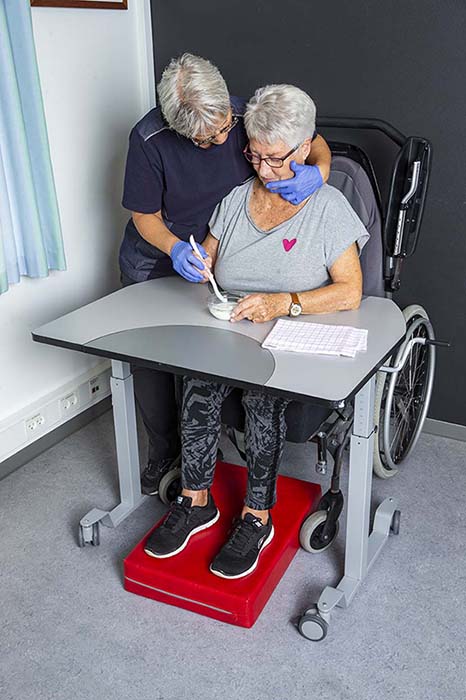
Therapeutic eating is conducted here as an examination where the patient is guided in the pre-oral phase to move the spoon to the mouth. The focus is on eye-hand and hand-mouth coordination.
In this setup, the ErgoMulti Table functions as an Accessible table, providing the necessary forearm and elbow support during the eating activity.
The carving of the ErgoMulti Table makes it possible to support the patient’s forearms and elbows while seated. This ensures stability and controlled movement throughout the task.
This Accessible table setup makes the movement more precise and supports coordination training during therapeutic eating.
The patient sits in a comfort wheelchair because she has limited body stability and cannot sit without support. To optimise positioning at the ErgoMulti Table, adjustments are made to the wheelchair:
This positioning ensures weight-bearing through both the arms and the feet, creating a more stable and functional sitting posture at the Accessible table.
As the patient cannot hold her head independently, the occupational therapist uses a jaw hold. She stands on the right side of the patient to support the body, head and jaw position during the examination.
The rounded edges of the ErgoMulti Table make it possible for the occupational therapist to get close to the patient. This proximity allows better support of the patient’s exit position while simultaneously ensuring an appropriate and ergonomic working posture for the therapist.
In this way, the ErgoMulti Table serves both as an Accessible table for the patient and as a tool that supports safe and effective working conditions for the professional.
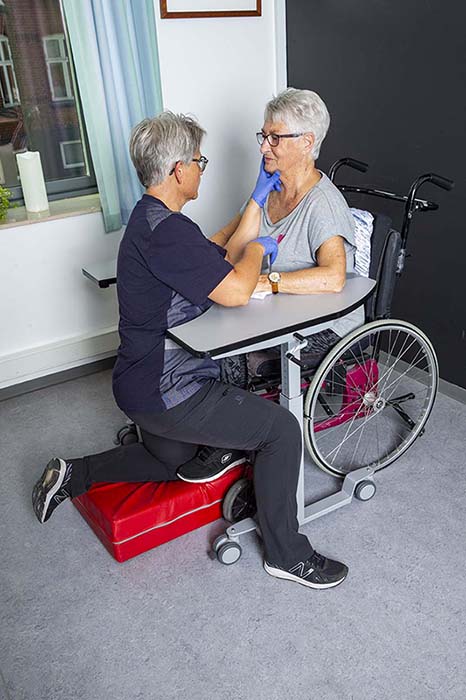
The patient is examined with a tactile examination of the mouth, where sense of feeling, mouth movement and saliva swallowing are assessed. In this situation, the ErgoMulti Table functions as an Accessible table, supporting both correct posture and precise clinical assessment.
The patient sits in an active wheelchair because controlled support is required during the examination. To achieve an optimal position at the ErgoMulti Table, several adjustments are made:
This Accessible table setup ensures stable weight-bearing through the arms and promotes proper head and upper body alignment during the tactile assessment.
In this example, the patient could also sit on an ordinary dining chair without arm supports, with a pillow or wedge in the back and the feet placed on the floor, while still benefiting from the support provided by the ErgoMulti Table.
The ErgoMulti Table’s two carvings make it possible for the occupational therapist to sit below eyesight, close to the patient and maintain good eye contact from the front. This positioning is important for achieving both clinical precision and effective communication.
At the same time, the Accessible table design allows the therapist to maintain a stable working position while supporting the patient with a jaw hold from the front.
By enabling close proximity and elbow support, the ErgoMulti Table supports both patient safety and ergonomic working conditions during tactile oral examinations.
In the descriptions, Anette uses the ErgoMulti table in specific rehabilitation situations with a patient. It is a professional evaluation of how the table works using occupational therapeutic methods. Anette’s professional assessment confirms that the ErgoMulti table is ideal for rehabilitation, and it demonstrates how the tables well thought out design makes it possible to help and support the patient in the best possible way.
With the right aids in training, therapy and rehabilitation, the patients will experience faster progress in the rehabilitation, and the occupational therapist gets the optimum working positions. In consequence, the table helps both patients and professionals to get a better everyday life.
Annette Kjærsgaard, occupational therapist with a PhD in dysphagia, owner of Dysfagiklinikken (Dysphagia Clinic).
Annette Kjærsgaard was trained as an occupational therapist in 1989, and in the mid-1990s she participated in designing the ErgoMulti table. Since then, Anette has taken a Ph.D. in dysphagia and has more than 30 years of experience in examination and treatment of face, mouth and throat. Also, Anette holds a master’s degree in occupational therapy (MScOT), is Facial-Oral Tract Therapy (F.O.T.T.) instructor and an occupational therapy specialist in neurorehabilitation. Read more about the Dysphagic Clinic here.


